

Audiences today are exhausted by the shear volume of content and content that’s just a commodity — created without inspiration, deep thought, purpose or strategy.
A quick look at your analytics is revealing: high bounce rates, flat dwell times, and too low conversion rates struggling below 1%. When every article is a carbon copy of a carbon copy, prospective buyers scroll past without registering your message. Been there, seen that.
And often, their disinterest isn’t the topic — let’s say a destination, resort, tour, itinerary, or travel stories being told. The issue, the real weakness is the content angle and how it actually performs for the content funnel.
The Real Definition of a Content Angle
We might define the content angle as the distinct lens, argument, and point of view through which a topic is explored and experienced. You might even think of it as a lens. The angle doesn’t just a catch attention, it represents the perspective you need them to view in order to make your brand look significant, and that you as a travel advisor are credible and empathize with their travel dream and needs. I mention this last point, because research shows your angle demonstrates your authoritative/expertise which it turns out, is what makes readers continue reading.
The content angle can communicate more about your brand values, quality of your business and the authority of your content’s authors (e.g., travel advisors). Consider the lasting effect of your chosen content angle since it’s the initial lens that conditions what the visitor feels about the topic and the company.
In 2004, psychologist and neuroscientist Ullrich Ecker published a study on article headlines. Participants were asked to read either a version with a headline designed to slant their perception one way, and the other half received a version with a headline designed to slant it the other way. They found readers perception of the subject was indeed altered by slant of the headline (the angle) they were given. And there was more.
The headline also changed which details they were able to remember, and how well they could recall them. People remembered differently, depending on the way the title framed the piece. Framing, in other words, dictates recall of what they thought the post was all about. Below, we explore framing.
Angles don’t just influence whether readers click. They determine how they experience your content.
You might have approached this quest — your question, about how to create content angles merely by finding something uniquely creative or quirky to catch attention, as though that will be enough. It likely won’t be enough.
What Will Your Content Angle Ultimately Achieve?
Consider first what the angle will lead to. Because the angle will fixate an idea in readers minds and this will color the rest of their experience with the article and then as they explore your pages, brand and UVP. Your task is to create a content angle with a great hook that has some weight and actually does generate a lead or sale. It connects well to the essential benefits they find compelling.
The question you’ll face is about how the angle ultimately serves the objective of getting a clickthrough, making impact, to deepen emotional engagement and generate a lead. If you follow through with your quickly selected angle/hook, it might work at first, but then you might realize it was maybe a little too cheeky and gimmicky. The leads generated went nowhere.
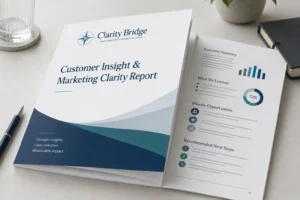
This is where your data and content testing system come into play to find out why the lead became a dead end. The angle has to align with traveler’s intent — so you must know your customer. That’s why I created the Customer Insight and Marketing Clarity Report — an in-depth exploration that includes a close look at your business’s content, especially the key content that drives most of your business.
To capture travel consumer’s attention in a landscape flooded with generic AI summaries and low quality, recycled blog posts, content strategists and creators must consider a more structured approach to framing ideas so they provoke thought, make impact, hold attention, and drive measurable action.
Topic vs. Angle vs. Hook: Understanding the Difference
What we need to avoid is in treating a broad topic as if it were a complete content strategy. The content angle then, is only part of the persuasive, engaging content experience you hope to offer your visitors.
- The Topic: The broad subject matter (e.g., Yosemite National Park).
- The Angle: The distinct perspective, argument, or lens you use to approach that subject (e.g., 5 Yosemite Hiking Trails with Epic, Post Card Views).
- The Hook: The provocative opening line or concept that pulls the reader into the piece (What is about Yosemite that is so hypnotic?).
The Angler’s Metaphor: Think of your content like fishing. The angle is the location, depth, and direction of your cast; the hook is the sharp bait that secures the initial bite.
The Yosemite Test: Turning Commodity Topics into Compelling Angles
Consider what happens when a traveler searches: “Why visit Yosemite Park?”
Standard search engine results typically serve a generic list: “10 Tips for Your Yosemite Vacation.” It’s functional, but it lacks emotional pull and fails to differentiate the author.
| Approach | Working Title | Core Strategic Angle |
| Commodity Approach | 10 Best Things to Do in Yosemite | Generic guidebook summary with no point of view. |
| Contrarian Angle | Why Visiting Yosemite in February Beats Peak Summer | Challenges conventional travel timing to highlight lower crowds and winter scenery. |
| High-Stakes Narrative | What Solo-Climbing Half Dome Taught Me About Risk Management | Blends physical adventure with psychological insight. |
| Sub-Niche Precision | The Exact 48-Hour Window to Photograph the Horsetail Firefall | Targets serious photographers with ultra-specific timing and location data. |
By narrowing the focus and adopting a clear thesis, you transform a generic informational query into an engaging narrative that speaks directly to a defined audience.
The 4 Strategic Pillars of Content Angles
The best, strategic approach to take, is to categorize your ideas into four core archetypes based on your business objectives:
1. Perspective & Authority
- Executive / Critic Counterpoint: Examine your industry through the eyes of an outspoken critic or unconventional leader.
- Original Subject-Matter Interviews: Pull unvarnished perspectives from operational experts rather than public relations statements.
- First-Person Immersion: Put the writer directly into the customer experience (e.g., walking the actual ground or testing the product under stress).
2. Contrarian & Tension
- Industry Myth-Busting: Directly challenge a sacred cow or widespread bad advice in your niche.
- The “Cost of Failure” Breakdown: Analyze a public mistake, misstep, or outdated tactic and extract actionable lessons.
- Unconventional Comparisons: Contrast your topic with an unexpected parallel from an entirely different industry.
3. Human Narrative & Immersion
- Sensory Storytelling: Frame solutions through real human outcomes, emotional friction, and tactile experiences.
- The Case Study Arc: Follow a specific individual or client navigating a complex hurdle from tension to resolution.
- Historical Parallels: Draw lessons from past events or market cycles that mirror today’s business landscape.
4. Data, Timing & Precision
- Proprietary Trends & Surveys: Base your thesis on primary research data or aggregated user behavior.
- Strategic News Analysis: Skip surface-level reporting; focus exclusively on the second- and third-order consequences of recent industry shifts.
- Deep-Dive Sub-Niching: Isolate one neglected micro-component of a broader system and explore it exhaustively.
Case Study: Analyzing the Angle of This Article
To see how angles function in real time, examine the structure of this post:
- The Broad Topic: Content marketing best practices.
- The Specific Angle: Digital fatigue and commodity content are destroying conversion rates; a structured 4-pillar angle framework is the strategic antidote.
- The Hook: Framing audience disengagement as a measurable commercial problem that standard content production cannot solve.
By addressing a recognized business friction upfront, the content delivers strategic utility/expertise rather than basic copywriting advice and gimmicks which may drag the brand image downward.
An 8-Point Checklist to Evaluate Your Angle Before Publishing
Before greenlighting a content brief or draft, run your proposed angle through these criteria:
- Does this perspective challenge or expand upon the top three search results for this query?
- Is the point of view tailored to a specific buyer persona rather than a generic reader?
- Does the angle naturally support your core brand positioning and unique value proposition?
- Is there sufficient evidence, data, or firsthand experience to defend the thesis?
- Does the framing introduce healthy tension or curiosity within the first two paragraphs?
- Would this perspective stand out in an industry newsletter or social feed?
- Is the argument structured so that an automated summary cannot replace reading the full piece?
- Does the conclusion guide the reader toward a logical, high-value business action?
Of course, your interesting content angle might spawn even more interesting hooks to use in social media posts or other promotions.
Upgrade Your Content Strategy
Great content pieces complete with a winning content angle help power up lead generation. They capture more of the customer’s intent to purchase and ultimately that will mean more purchases and perhaps a bigger spend. Strong impact and reading pleasure launch them into a richer relationship with your business and your travel advisors and CSRs. How does great content power up lead generation?
Developing sharp, high-converting content angles requires deep customer insight, industry perspective, and disciplined execution.
After establishing your content strategy, goals and objectives, using this process, you may find your imagination is becoming more accessible too. Confusion can shut down the imagination and brainstorming process, while clarity open it up.
A Content Marketing Institute Study (2026) found that among marketers whose content strategy improved, 74% attributed the improvement to strategy refinement—more than the 51% who credited new technology. Given how most are using AI to create content, it seems those with greater, granular awareness of what they were doing, were more successful.
As you can see, good content angles have to be thought out and perhaps tested before large scale implementation, because your audience is unique, your real goal is leads, sales and revenue.
Consider the Clarity Bridge Customer Insight and Marketing Clarity Report as your go to guide to make your marketing strategy truly magnificent.