
How You Can Tap Into the Full Value of What You’ve Built
Most small business owners build their companies by learning to read situations well.
They get to know their customers, stay aware of the market, develop instincts about which opportunities are worth pursuing, recognize when something is starting to go wrong, and learn where their time and money are best spent. Over the years, that accumulated judgment becomes one of the most valuable assets in the business.
Experience matters. Intuition matters. So does the courage it took to build the company in the first place. Your list of strengths is likely long.
But as your business grows, something subtle begins to change.
More, More, More. But Less Insight
You have more customers, more inquiries, more employees, more marketing channels, more website activity, more sales conversations and more competitors. Information begins to accumulate in places that did not even exist when the business was smaller: CRM systems, analytics platforms, advertising accounts, customer records, email campaigns, call notes and spreadsheets.
The owner may still understand each part individually. What becomes harder is seeing what all of those signals are saying together.
In that sense, this is the knowledge of your business and it may know more than you think.
Growth Creates a New Kind of Challenge
Growth and more transactions are simply a consequence of success and running a healthy business. Customers like what you offer, and others see that.
When the business was smaller, you could keep much of it in your head. You knew the customers personally. You understood where the leads were coming from. You probably had a close feel for which marketing efforts were working and where opportunities were being lost.
As the company grows, that same level of visibility becomes harder to maintain.
The information is still there, yet it’s fragmented. Some appears in website analytics. Another sits in a salesperson’s notes. More is buried in customer histories. Advertising platforms contain another part of the story, while repeat bookings, lost clients and unanswered inquiries reveal something else again.
This is where owners often begin to feel the strain personally. You’re expected to make the important decisions, but you likely have even less time to investigate every question properly.
- Why are some leads converting while others disappear?
- Which marketing channels are producing the most valuable customers?
- Are certain customers more profitable over time than others?
- Where are we losing revenue?
- Which markets deserve more attention?
- What should we stop doing?
Those are not small questions. They influence growth, profitability, staffing, marketing investment and the confidence with which an owner can move the business forward.
Yet many of them remain partly unanswered.
The Information May Already Be Inside the Business
One of the most encouraging things about this problem is that a business does not necessarily need to begin by collecting huge amounts of new data.
It may already possess much of what is needed.
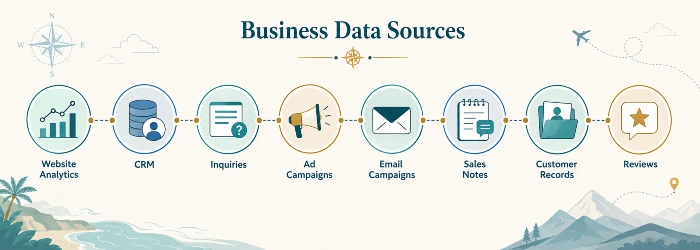
Customer records can reveal purchasing patterns. Inquiry histories can show where interest originates. Advertising data can be compared with eventual sales outcomes. Website behavior may reveal what prospects are trying to understand before they make contact. Lost customers can tell us something very different from loyal ones.
Even surveys you’ve conducted and the questions customers repeatedly ask can become useful evidence.
The challenge is bringing those pieces together.
You may already suspect that one marketing channel performs better than another, or that certain customers are particularly valuable. Good analysis may not overturn that belief.
Very often, it can strengthen it.
Your experience and intuition have brought the business this far. Your data can now help confirm what you already suspect, reveal what you haven’t been able to see, and refine where you put your attention next.
That makes analysis an extension of your good judgment, rather than a replacement for it.
Better Insight Can Increase Decision Capacity
Small business owners don’t need more information. Most already have more than they can comfortably absorb. Fact is, data today is overwhelming.
What’s needed is greater decision capacity.
That means having enough clarity to understand what deserves attention, enough evidence to feel confident about a decision, and enough perspective to act before a problem becomes more expensive.
This is important since uncertainty carries a cost.
A travel ad campaign may continue longer than it should. Good home seller leads may quietly disappear. Valuable past SaaS customers may not be contacted again. Marketing dollars may be spread across too many priorities because nobody feels confident enough to narrow the focus to the ones that matter (the 20% that create 80% of your profit)
Individually, those losses can seem manageable, but over time, they add up.
The financial pain of incomplete visibility rarely arrives all at once. More often, the business simply has lower visibility, less interest and inquiries, fewer leads with fewer becoming sales opportunities. And not knowing why becomes the biggest source of anxiety — and that would cripple anyone’s decision powers.
This can be frustrating for an owner who knows the company is capable of better results.
This Is Where AI Becomes Useful
Artificial intelligence is receiving so much attention that it’s easy to make the technology itself the story. For most small business owners, that’s not really helpful.
The more interesting opportunity is that AI now makes it practical to examine far more business information than a small company could reasonably study before. Customer histories, marketing results, sales activity, website behavior and outside market information can be brought into a much clearer picture.
That does not mean turning decision-making over to AI systems. Instead, it means giving an experienced business owner more evidence to work with.
The judgment remains yours because you’re the person who cares and has a true feel for the business and your customers.
What changes then, is how reporting increases the view of your business to help expose the real sources of loss and profit, and weak performance.
A Business You Already Know — Seen More Clearly
Consider a Toronto travel agency owner who has spent years learning the business, building relationships, developing advisors and understanding what GTA region travelers value.
That experience cannot be replaced by software or Agentic AI bots.
Your travel agency as an example, may now contain years of information about which customers return, which inquiries turn into valuable bookings, which destinations perform particularly well for the local Toronto traveler market and where good prospects tend to disappear. It might reveal traveler habits and destination choice changes as economic and political winds hit the Toronto and Canadian marketplace.
Much of that knowledge is already present. It has simply never been brought together in a way that allows the owner to see the larger pattern.
This is what makes this kind of analysis so encouraging.
It is not about discovering that everything has been done incorrectly. Quite the opposite. The findings may confirm instincts the owner has developed over many years. They may explain why something has been working. They may reveal an opportunity that has been quietly taking shape in the background.
And sometimes they may provide enough evidence to make a difficult decision feel much easier.
More Clarity, Without More Burden
Small business owners already have enough demanding their attention.
The last thing they need is another complicated initiative that creates more meetings, more software and more work for everyone around them.
What they often need instead is someone who can take a closer look at what is already there, make sense of it, and bring back the findings in a form that is useful.
That is where I believe I can help.
My role isn’t to arrive and tell an owner how to run the business they have spent years building. Your expertise is the business. My intention is to bring additional analytical capacity to the questions the owners is hoping answer.
I can do the digging.
I can bring the pieces together.
And then we can look at what the evidence suggests in the context of the owner’s experience, ambitions and knowledge of the business.
The result should feel less like a consulting exercise and more like finally being able to see something that had been difficult to see before.
Let the Business Speak
The business then, actually possesses the insights needed to help you plan the direction you’re ship needs to sail. It can help you avoid the rocky shoals or massive storm winds, and get you safely to ports where your best value is delivered.
A successful small business represents years of decisions, relationships, experimentation and hard-earned knowledge.
Our business and sales history has significant value. It shouldn’t go to waste, because AI can unearth amazing insights.
Your customers have been telling you things. Your marketing has been producing signals. Your sales activity has been leaving clues about what creates stronger results and where opportunities may be going unnoticed.
There may be much more intelligence inside the business than anyone has had the time to uncover.
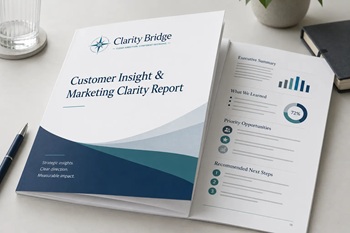
That is the idea behind the value for clients that I’m building at Clarity Bridge.
I use AI-assisted research and analysis to help owners understand more of what their customer, marketing and sales information is already telling them. The objective is simple: clearer understanding, greater confidence, and a stronger basis for deciding where to focus next.
You built the business. You know its people, its customers and its possibilities.
Sometimes the next step is simply having someone you trust help you see more of what you already have.