

Specialized Focus Opens Your Agency to Wonderful, Profitable Opportunity
International travel is entering an unusually interesting period for US travel agencies.,
The story is bigger than the post-pandemic recovery. Travelers are moving again in enormous numbers, airlines are opening new routes, established destinations remain powerful, and a wider range of places is becoming practical for American travelers to consider.
For agency owners, this creates something more valuable than simple market growth: more opportunity to decide which travelers, destinations and experiences their agency wants to become known for.
The International demand numbers provide a strong foundation. UN Tourism estimates that 1.52 billion international tourist arrivals were recorded worldwide in 2025, up 4% from 2024, with Europe attracting 793 million visitors and Asia-Pacific growing 6%. International tourism export revenues reached an estimated $2.2 trillion. UN Tourism Secretary-General Shaikha Alnowais summarized the strength of the market simply: “Demand for travel remained high throughout 2025.”
Barring any economic collapse, there are global destinations that will provide the highest returns over the next 5 years and more.
For U.S. travel agencies, the outbound travel numbers are particularly encouraging too.
Americans Are Already Demonstrating this Opportunity
U.S. outbound travel is surging—with 29.1 million international trips taken in the first five months of 2026 alone (a 23% increase over 2019 levels). Americans booked a record 107.7 million international trips in 2024, according to the National Travel and Tourism Office. Of those, 53.8 million were overseas trips, almost 20% above 2019 levels.
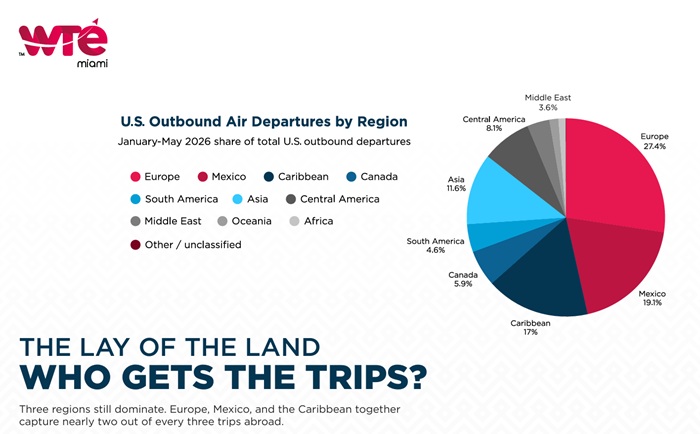
Those overseas travelers are attractive customers. Their average household income was approximately $163,000. They stayed abroad an average of 15.3 nights, spent $1,907 outside the United States, excluding much of the cost paid before departure, and began planning an average 109 days ahead.
Vacations represented 61% of those trips. But what travelers did when they arrived is even more revealing: 81.6% went sightseeing, 46.1% visited small towns or countryside, 43% visited historical locations and 38.6% participated in guided tours.
This describes a traveler with time, financial capacity and curiosity—someone who places greater value on the quality of the journey than on simply finding the easiest or cheapest way to book it.
And that distinction is important for travel agencies deciding where to invest their marketing energy, and designing their customer’s International travel shopping experience.

The Best Opportunity May Be a Better Traveler
We are focusing on the best international destinations to sell, but in doing so we discover something even more lucrative–well-targeted, financially able, and reliable customers. This is the more difficult part of the demand equation which is why agencies struggle with it.
Phocuswright’s latest U.S. travel agency research provides another useful clue about this better traveler profile.
More than three quarters of advisor clients are over 40, 44% are over 55, and six in ten have household incomes of at least $100,000. Yet advisors say only 2% of their clients primarily choose them because they offer the lowest price.
Relationships, customer service and knowledge of destinations and travel products matter much more. A customer with a real need they respect themselves suggests a better customer. Agency sales are also outperforming the broader travel market, with exclusive and higher-end travel among the strongest areas.
That suggests an intriguing growth question for an agency owner.
Rather than simply asking, How can we generate more leads?, perhaps the better question is:
Key Question: What Kinds of Travelers Would Value What our Advisors are Exceptionally Good At?
Your marketing matches up the ideal traveler to the ultimate services your advisors can deliver.
A financially comfortable couple in their 40s, 50s or 60s planning a substantial international journey can represent a very different business opportunity from a price-led shopper.
They may want Italy, Japan or France. Or they may be receptive to something less obvious: Slovenia instead of the busiest parts of the Mediterranean; Norway or Ireland during the height of summer; Porto rather than another stay in Lisbon; Sardinia instead of repeating the same Italian itinerary.
They are adventurous, but discerning. They appreciate discovery while still caring about safety, comfort, quality, reliability and the intelligent use of their vacation time.
That is an attractive customer relationship to acquire—and potentially to retain for many future journeys.
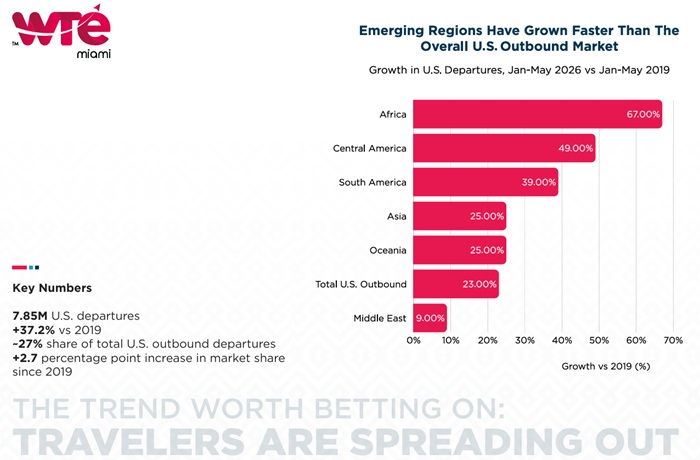
The International Map Is Expanding
Airlines provide another source of useful business intelligence.
New routes don’t automatically make a destination a great agency market. But they can materially change accessibility, awareness and traveler interest.
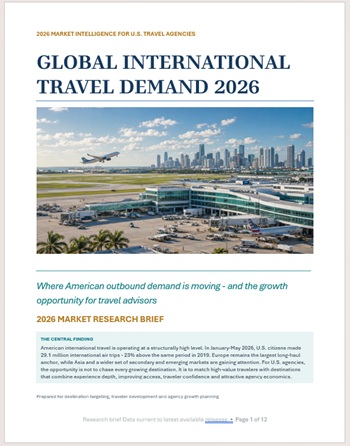
Note: The Clarity Bridge Global International Travel Demand 2026 Report is available. Please contact for a copy.
Delta Airlines is operating its largest transatlantic schedule ever in summer 2026, with more than 650 weekly flights to almost 30 European destinations. Its new services include New York to Sardinia, Malta and Porto, along with new routes from Boston to Madrid and Nice and Seattle to Rome and Barcelona.
American Airlines has simultaneously opened new nonstop service from Philadelphia to Budapest and Prague, while adding Dallas-Fort Worth service to Athens and Zurich. American says it is operating as many as 70 daily U.S.-Europe flights this summer.
There is an interesting strategic signal here.
When direct access improves, an agency can begin examining the destination before it becomes just another heavily marketed commodity. New supplier relationships can be developed. Advisors can learn the region. Itineraries can be created. Existing clients can be segmented. Content and email campaigns can begin creating awareness.
A new flight is therefore more than transportation.
It can be the beginning of a new travel product.
Opportunity Needs More Than a Growth Statistic
This is where your destination selection becomes more sophisticated.
An emerging destination might be receiving substantially more visitors, appearing frequently in travel media or benefiting from new air service. That makes it worth investigating. It doesn’t necessarily make it appropriate for every agency.
A useful destination opportunity assessment should consider at least six things:
Demand strength. Is traveler interest substantial and sustainable?
Traveler value. Does the destination attract customers whose trip value, spending and repeat potential fit the agency?
Experience depth. Can advisors create distinctive journeys rather than a standardized package?
Access and destination conditions. Are airlift, transportation, infrastructure, seasonality and safety conducive to the travelers the agency serves?
Advisor fit. Can the team develop enough knowledge, supplier support and enthusiasm to sell it confidently?
Commercial quality. After commissions, supplier terms, marketing costs, service requirements and advisor time, is this genuinely good business?
Safety belongs naturally within this assessment. Some travelers will enthusiastically consider an unfamiliar destination while removing another from consideration because of security concerns, political instability, entry procedures, healthcare availability or simply their own comfort level.
The advisor’s role is to introduce the right destinations and experiences and help travelers explore them confidently and appropriately. Of course, our online content strategy would involve a guided experience that is fun, thorough with the right progressions, filling all gaps for a smooth booking experience – backed by the assurance of a skilled, capable travel advisor and travel agency brand.
Government advisories and AI can provide information. Booking sites can provide availability. An experienced advisor can interpret all of that in the context of an actual client, an actual itinerary and the alternatives available.
For uncertain travelers, that offers considerably more valuable.
The Trip Itself Is Changing Too
Premium travel research points toward another opportunity: travelers increasingly want experiences that are difficult to commoditize.
Phocuswright’s 2026 research into high-spending “indulgent explorers” finds that these travelers over-index on longer trips, greater in-destination spending and premium trip components, and nearly three quarters take multiple qualifying premium trips per year. What makes premium travel worthwhile includes exceptional service, privacy, effortless travel and access to experiences travelers would struggle to arrange independently.
Virtuoso’s research shows similar momentum around family and celebration travel, adventure, cultural experiences, food, wellness and journeys beyond the most familiar tourist circuits. Its recent destination research has highlighted places such as Portugal, Iceland, Norway and Morocco while Italy, Greece, France and Japan remain powerful international favorites.
This gives agencies room to work at both ends of the opportunity.
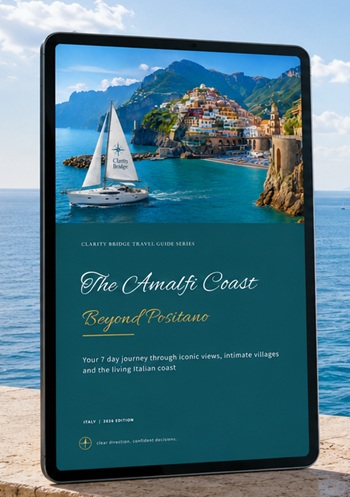
There are enormously valuable established destinations where deeper specialization can produce better itineraries—Amalfi and Puglia rather than simply Italy; Kyoto, ryokans and regional rail rather than simply Japan.
Then there are destinations still moving into broader consideration: Slovenia, Albania, Poland, Northern Ireland, parts of Scandinavia and Central Europe, along with carefully selected opportunities farther afield.
The objective is hardly to chase every new destination.
It is to discover which new opportunities belong to your agency (e.g., signature destinations you want to own).
From Market Insight to an Advisor Conversation
This is where international growth becomes a marketing question.
Once an agency identifies a promising destination and traveler, the work has only begun.
What does that traveler really want from the trip? What will make the destination compelling to them? Which experience differentiates the agency? Where does that traveler look for inspiration? What questions arise during consideration? What content builds confidence? Which inquiries deserve priority? Which advisor should receive them?
These questions connect destination research directly to content, search visibility, advertising, email, customer insight, lead qualification and conversion.
They also create a more interesting form of growth.
Instead of wasteful marketing a catalog of destinations and experiences to everyone, an agency can deliberately develop selected destinations and attract travelers who value its knowledge, care and ability to create memorable journeys.
The international market already has momentum. More destinations are becoming accessible. Travelers have more choices. Affluent and experience-oriented customers continue to spend.
For agency owners, the opportunity is to become more selective rather than more scattered. Now the question might be: which destination should you own?
Choose good markets. Develop genuine expertise. Attract travelers worth knowing. Give advisors journeys they are excited to sell.
There is a remarkable world of travel opportunity opening up.
US travel agencies that study it carefully now may discover some very valuable places to grow next. A travel marketing consultant who focuses on data and creative ideas might be a big helper.
Ask for your customized Clarity Bridge Business Insights and Marketing Clarity Report for Travel Companies and open to up intelligent growth.